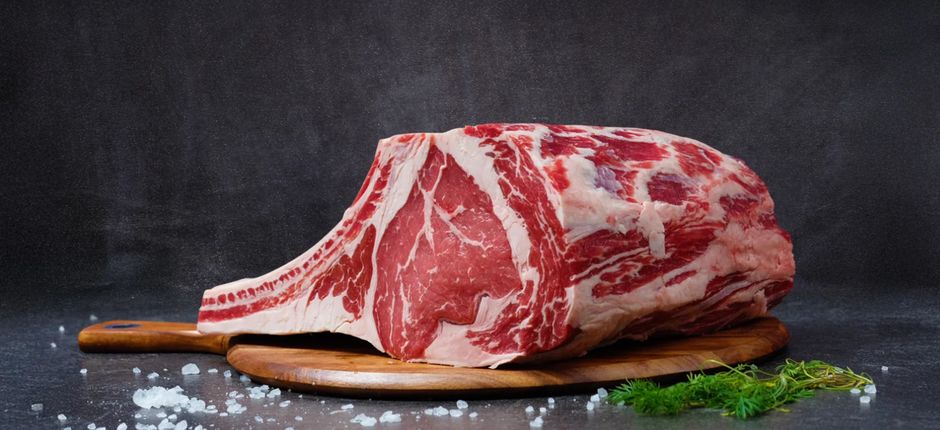
Prime Rib Recipe That'll Make Your Oven Nervous
Season a bone-in prime rib roast generously with salt, herbs, and garlic, then roast low and slow at 250°F until the internal temperature reaches 120°F for medium-rare. Finish with a high-heat sear at 500°F for 10 minutes to build a dark, crackling crust.
I volunteered to make prime rib for a Christmas dinner hosted at a friend's place, and I want to be honest: I volunteered before I fully understood what prime rib required, which is a tendency I have not entirely corrected. I had made it once before, many years prior, with results that were technically edible but overcooked at the edges and underseasoned throughout. I did not share this with the group when I volunteered.
The difference between the prime rib I'd made before and the one I made this time was the reverse sear method, which I'd read about and which removed most of the variables that make a large roast difficult. The traditional method — high heat blast at the start to sear, then low heat to finish — creates a wide band of overcooked meat beneath the crust. The reverse sear does it backward: slow and low at 250°F until the roast reaches about 120°F internally, then pull it out, crank the oven to 500°F, and return it for twelve to fifteen minutes for the crust.
The slow low phase takes two to three hours depending on the size of the roast. It cooks the interior evenly wall-to-wall, so every slice from edge to center is the same pink color and the same temperature. The brief high-heat blast at the end sears the crust without cooking the interior further. You get the exterior browning and the even interior cook in the same roast, which is the thing you're always trying to do and can't achieve easily with the traditional method.
Season the night before with salt and refrigerate uncovered. The salt draws out moisture, which then reabsorbs, seasoning the meat more deeply and drying the surface for a better sear. The Christmas dinner was well-received. I have been making prime rib with appropriate confidence ever since.
Ingredients
- 1 bone-in prime rib roast, 4 bones (approximately 8–9 lbs)
- 2 tablespoons kosher salt
- 2 teaspoons freshly ground black pepper
- 2 tablespoons fresh rosemary, finely chopped
- 2 tablespoons fresh thyme leaves
- 8 cloves garlic, minced
- 3 tablespoons extra-virgin olive oil
- 1 tablespoon Dijon mustard
- 1 teaspoon onion powder
Instructions
- 1The night before (or up to 48 hours ahead): Pat the prime rib completely dry with paper towels. Rub the entire surface —? top, sides, and between the bones —? with kosher salt. Place the roast bone-side down on a wire rack set inside a rimmed baking sheet. Leave uncovered in the refrigerator overnight. This is the step most people skip because they didn't plan ahead. Plan ahead.
- 2Two hours before cooking, remove the roast from the refrigerator and let it sit at room temperature. Cold meat cooks unevenly, and uneven is not the goal here.
- 3Preheat your oven to 250°F. In a small bowl, combine the black pepper, rosemary, thyme, minced garlic, olive oil, Dijon mustard, and onion powder into a paste. Rub this paste over the entire roast, pressing it into the surface.
- 4Set the roast bone-side down on the wire rack in the baking sheet. Insert a leave-in probe thermometer into the thickest part of the roast, away from any bone. The bone reads hotter than the meat and will lie to you.
- 5Roast at 250°F until the internal temperature reaches 120°F for medium-rare (about 3 to 3.5 hours for an 8–9 lb roast). This is your pull temperature —? the roast will carry over during the sear. If you want medium, pull at 130°F.
- 6When the roast reaches temperature, remove it from the oven and tent loosely with foil. Increase oven temperature to 500°F and let the oven fully preheat —? this takes 15–20 minutes. Do not rush this step. The oven needs to mean it.
- 7Once the oven hits 500°F, remove the foil and return the roast to the oven. Sear for exactly 8–10 minutes, until the exterior is deeply browned and the herb crust is crackling. Watch it. This is not the moment to check your phone.
- 8Remove from oven and rest uncovered for 20–30 minutes. The internal temperature will rise another 5–8 degrees during this rest. Carve between the bones for bone-in portions, or remove the bones as a slab first and slice the roast into ¾-inch to 1-inch steaks.
Pro Tips
- Salt the roast the night before, full stop. Dry brining overnight builds flavor in the crust and helps moisture stay inside the meat where it belongs —? a lesson I learned too late and still think about.
- Use a reliable leave-in probe thermometer, not an instant-read you stab in repeatedly. Every time you open that oven to check, you are costing yourself time and heat. The thermometer is doing the worrying so you don't have to.
- If you do not have a wire rack, set the roast on top of the bones you trimmed off, or on a bed of sliced onions. You want airflow underneath. A roast sitting in its own juices is a braised thing, not a roasted thing —? both are delicious, but only one of them is what we're doing.
Substitutions
Storage Instructions
Wrap leftover slices tightly in foil or store in an airtight container in the refrigerator for up to 4 days. To reheat without overcooking, warm slices in a 275°F oven until just heated through, about 15–20 minutes. Do not microwave. The microwave will do unspeakable things to it.
Make Ahead
Salt and dry-brine the roast up to 48 hours in advance, uncovered in the refrigerator. Apply the herb paste the morning of cooking or just before it goes in the oven. You cannot finish-cook this ahead and reheat it successfully at scale —? this is a serve-it-fresh situation.
Frequently Asked Questions
What internal temperature should prime rib be?
Pull the roast at 120°F for medium-rare —? it will carry over to about 125–128°F during the high-heat sear and rest. For medium, pull at 130°F and expect a finished temp around 135°F. Do not cook prime rib past medium. Past medium it becomes a different and sadder dish.
How long does it take to cook a prime rib roast?
At 250°F, plan on approximately 15–18 minutes per pound for medium-rare. An 8–9 pound roast takes roughly 3 to 3.5 hours in the low-heat phase, plus 10 minutes for the high-heat sear and 20–30 minutes of resting time. A thermometer is your actual answer —? time is just a rough guide.
Why did my prime rib come out gray and overcooked in the middle?
You pulled it too late, cooked it too hot, or both. A high oven temperature from the start creates a thick band of overcooked gray meat under the crust before the center catches up. The reverse sear method —? low heat first, high heat at the end —? solves this by bringing the whole roast to temperature evenly before the sear happens.
Can I make prime rib ahead of time for a party?
You can dry-brine it up to 48 hours ahead and have everything prepped and ready. The actual roast should be cooked and served the day of. If you need more flexibility, the low-temperature roasting phase can be done a few hours early; rest the roast loosely tented, then do the 500°F sear just before serving to reheat and crust it.
How do I store and reheat leftover prime rib?
Store wrapped tightly in foil in the refrigerator for up to 4 days. Reheat gently at 275°F in the oven for 15–20 minutes to avoid overcooking. Alternatively, slice thin and use cold leftovers for a prime rib sandwich, which is honestly one of the best reasons to make a roast this size in the first place.
Do I need to tie the prime rib roast before cooking?
If you're cooking bone-in, the bones act as a natural rack and the roast holds its shape well. Tying is more important for boneless roasts to keep them from splaying open during cooking. If your butcher hasn't already tied it and it's boneless, tie it with kitchen twine at 1-inch intervals.
What size prime rib roast do I need for my guests?
A standard rule is one bone per two people, or about 1 pound of bone-in roast per person when accounting for the bone weight. A 4-bone, 8–9 lb roast feeds 8–10 people comfortably with sides. If you're feeding people who consider prime rib a light appetizer, scale up.
Should I cover prime rib while it roasts?
No. Cooking uncovered during the low-temperature phase allows the surface to dry slightly, which helps the herb crust set and promotes better browning during the high-heat sear. Tent it loosely with foil only during the resting period between the two cooking phases, then remove it entirely before the sear.