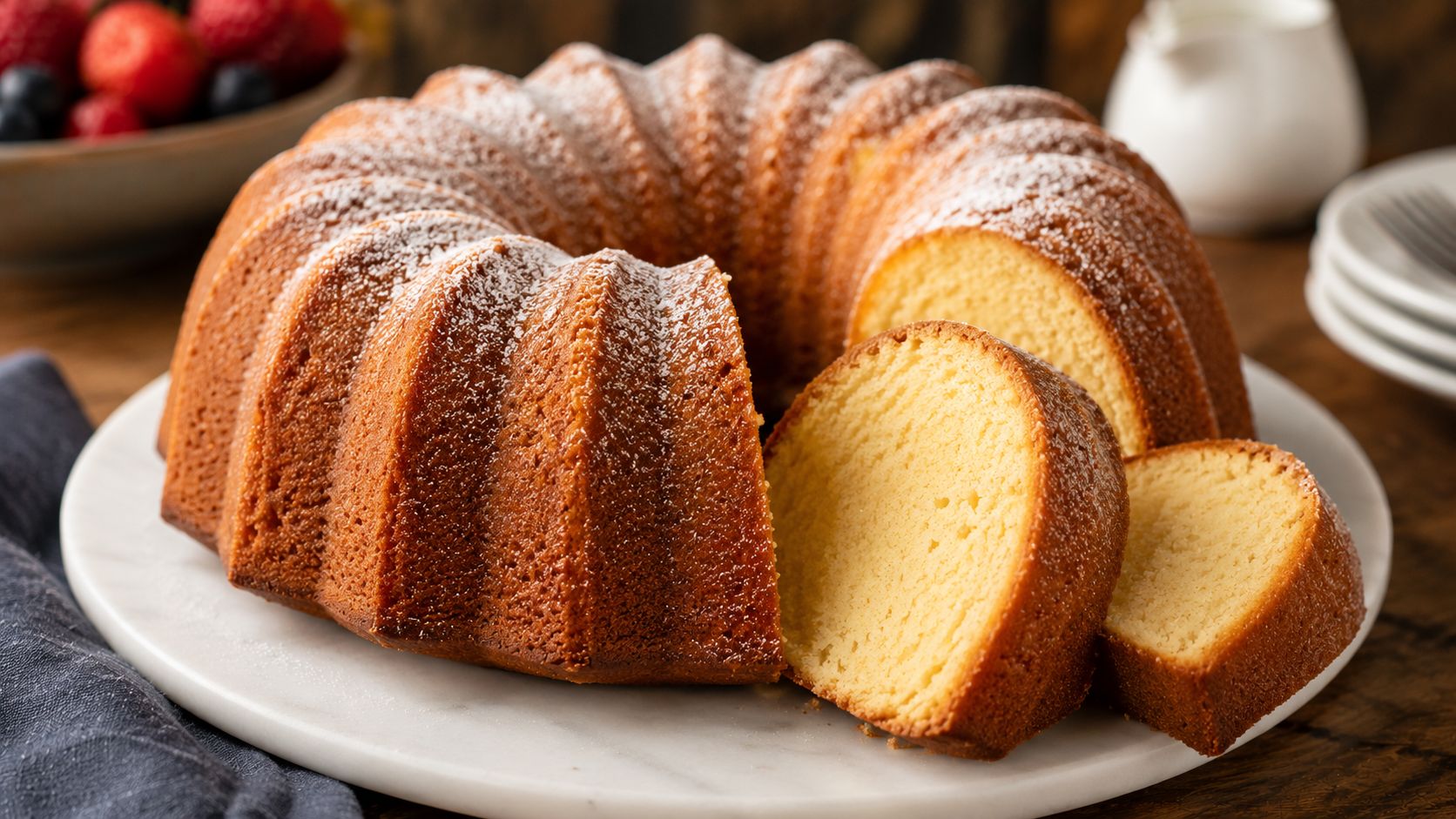
Pound Cake Recipe That'll Make You Sit Down Twice
To make pound cake, cream one pound each of butter, sugar, eggs, and flour together with a splash of vanilla, then bake at 325°F for 60–75 minutes in a greased and floured bundt or loaf pan. The low oven temperature is what keeps it tender and prevents cracking.
There was a woman at my office named Renata who brought pound cake to every retirement party, every birthday celebration, every going-away lunch. Always the same pound cake, wrapped in foil, presented without comment like it was obvious and expected. It was obvious and expected. People had started specifically requesting it. I took a piece at one of these events intending to eat it politely and spent the next ten minutes standing near the break room counter eating three more slices in what I would describe as a trance state.
I asked her what she did to it. She said: good butter, real vanilla, room temperature everything, and a low oven for longer than seems necessary. Four things. I wrote them down.
The butter quality matters because pound cake has nowhere to hide. There's no filling, no frosting, no competing flavors. The cake is butter, eggs, sugar, flour, and vanilla, and if any of those ingredients are subpar, the result reflects it directly. Room temperature butter creams properly and incorporates more air, which affects the texture. Room temperature eggs incorporate without seizing the butter. Cold eggs in creamed butter can make the batter break — it looks curdled and doesn't recover cleanly.
The low-and-slow oven — 325°F for an hour and fifteen minutes — produces the characteristic crack down the top, the golden crust, and the tight, dense crumb that makes pound cake distinct from every other cake. Rush it at high heat and the outside sets before the inside finishes. Low heat bakes it through evenly. Renata's version was better than mine. It's still the benchmark.
Ingredients
- 2 cups (4 sticks / 454g) unsalted butter, room temperature
- 3 cups (600g) granulated sugar
- 6 large eggs, room temperature
- 4 cups (480g) all-purpose flour, sifted
- 3/4 cup (180ml) whole milk, room temperature
- 2 teaspoons pure vanilla extract
- 1/2 teaspoon almond extract (optional but highly recommended)
- 1/2 teaspoon salt
- 1/4 teaspoon baking soda
Instructions
- 1Pull your butter, eggs, and milk out of the refrigerator at least 1 hour before you start. Room temperature is not a suggestion here —? cold ingredients will not emulsify properly and your crumb will suffer for it.
- 2Preheat your oven to 325°F (165°C). Grease a 10-inch bundt pan or a standard tube pan thoroughly with butter or shortening, then dust with flour and tap out the excess. Every crevice. The pan is waiting to embarrass you.
- 3In a large bowl, beat the butter on medium speed for 2 full minutes until it lightens slightly. Add the sugar and continue beating on medium-high for 5–6 minutes until the mixture is pale, very fluffy, and has nearly doubled in volume. Do not rush this step. It is the foundation.
- 4Add the eggs one at a time, beating for about 30 seconds after each addition. Scrape down the sides of the bowl with a spatula between every other egg.
- 5In a small bowl, stir together the vanilla extract, almond extract (if using), and milk.
- 6Whisk together the sifted flour, salt, and baking soda in a separate bowl.
- 7With the mixer on low, add the flour mixture and the milk mixture to the butter mixture in alternating additions —? flour first, then milk, back to flour, then milk, ending with flour. Three additions of flour, two of milk. Mix only until just combined after each addition. Overmixing activates gluten and toughens the crumb.
- 8Scrape the batter into the prepared pan and smooth the top. Tap the pan firmly on the counter two or three times to release any air pockets.
- 9Bake at 325°F for 70–80 minutes, until a wooden skewer or toothpick inserted in the center comes out clean or with a few dry crumbs. The top should be deep golden brown and the cake should have begun to pull away from the sides of the pan.
- 10Cool in the pan on a wire rack for 15 minutes, then carefully invert onto the rack to cool completely —? at least 1 hour —? before slicing. Cutting into a warm pound cake causes it to compress and lose its structure.
Pro Tips
- Room temperature really does matter: cold butter will not cream properly, and cold eggs can cause the batter to curdle. If you forgot to set them out, set the butter in 1-inch cubes on the counter for 45 minutes, and submerge the eggs in warm (not hot) water for 10 minutes.
- Cream the butter and sugar longer than you think you need to. If your mixture still looks yellow and grainy at three minutes, keep going. You want it pale ivory and light. This is where the cake gets its texture.
- If your pound cake cracks on top, that is correct and traditional and nothing to apologize for. It is not a failure. It is the cake being honest with you, which is more than most things will do.
Substitutions
Storage Instructions
Store cooled pound cake tightly wrapped in plastic wrap or in an airtight container at room temperature for up to 5 days. For longer storage, wrap individual slices in plastic wrap, then foil, and freeze for up to 3 months. Thaw at room temperature for 1–2 hours before serving.
Make Ahead
Pound cake is genuinely better the day after it is baked —? the crumb firms up and the flavor deepens overnight. Bake it the day before you need it, let it cool completely, wrap tightly in plastic wrap, and leave it at room temperature. Do not refrigerate before serving as this dries it out.
Frequently Asked Questions
Why did my pound cake come out dense and heavy instead of tender?
The most likely culprit is under-creamed butter and sugar. You need to beat them together for a full 5–6 minutes until the mixture is pale and nearly doubled in volume —? that process incorporates air, which is what lifts the cake. Cold butter or cold eggs can also cause the batter to seize and produce a tight, heavy crumb. Make sure everything is at room temperature before you start.
Do I really need to sift the flour for pound cake?
Yes, and this is one of the places the recipe will quietly punish you for skipping it. Sifting removes clumps and aerates the flour before it goes into the batter, which helps it incorporate evenly without overmixing. You do not need a fancy sifter —? a fine mesh strainer over a bowl works perfectly. It takes about 45 seconds and it matters.
Can I make pound cake in a loaf pan instead of a bundt pan?
Yes. Divide the batter evenly between two standard 9x5-inch loaf pans. Reduce the oven temperature to 325°F and begin checking for doneness at 55 minutes. Loaf pans will bake faster than a tube or bundt pan because the batter layer is shallower. A toothpick inserted in the center should come out clean with a few dry crumbs.
Why did my pound cake stick to the pan?
Bundt pans are decorative and unforgiving. Grease every ridge and crevice with softened butter or solid shortening (shortening actually works better than butter here because it does not contain water), then dust thoroughly with flour and tap out the excess. Let the cake cool in the pan for exactly 15 minutes before inverting —? not less, not much more. Too soon and it falls apart; too long and it steams and sticks.
Can I make this pound cake recipe without a stand mixer?
Yes, a hand mixer works fine. The process is identical —? you will just hold it yourself for the 6-minute creaming step, which builds character. A whisk and pure muscle technically works too, but your arm will file a formal complaint somewhere around minute four, and the texture may be uneven. An electric mixer of some kind is strongly recommended for this recipe.
Can I make this pound cake dairy-free?
You can substitute a high-fat vegan butter (such as Miyoko's or Earth Balance sticks) for dairy butter with reasonably good results, though the flavor will be slightly less rich. Replace the whole milk with full-fat oat milk or canned coconut milk. The texture will be slightly different —? a touch more dense —? but the cake will still be good. Skip the almond extract if there are nut allergies in the room.
How do I know when pound cake is fully baked?
Insert a wooden skewer or long toothpick into the thickest part of the cake. It should come out clean or with a few dry crumbs —? not wet batter. The top should be deep golden brown and the cake should have visibly pulled away from the sides of the pan. An internal temperature of 200–210°F on an instant-read thermometer is the most reliable confirmation.
Can I add a glaze or topping to this pound cake?
Absolutely. A simple vanilla glaze —? 1 cup powdered sugar, 2–3 tablespoons milk, 1/2 teaspoon vanilla, whisked together —? poured over the fully cooled cake is classic and takes about 90 seconds to make. Fresh berries and lightly whipped cream alongside a plain slice is also a perfectly correct choice. The cake is complete on its own, but it will not turn down company.