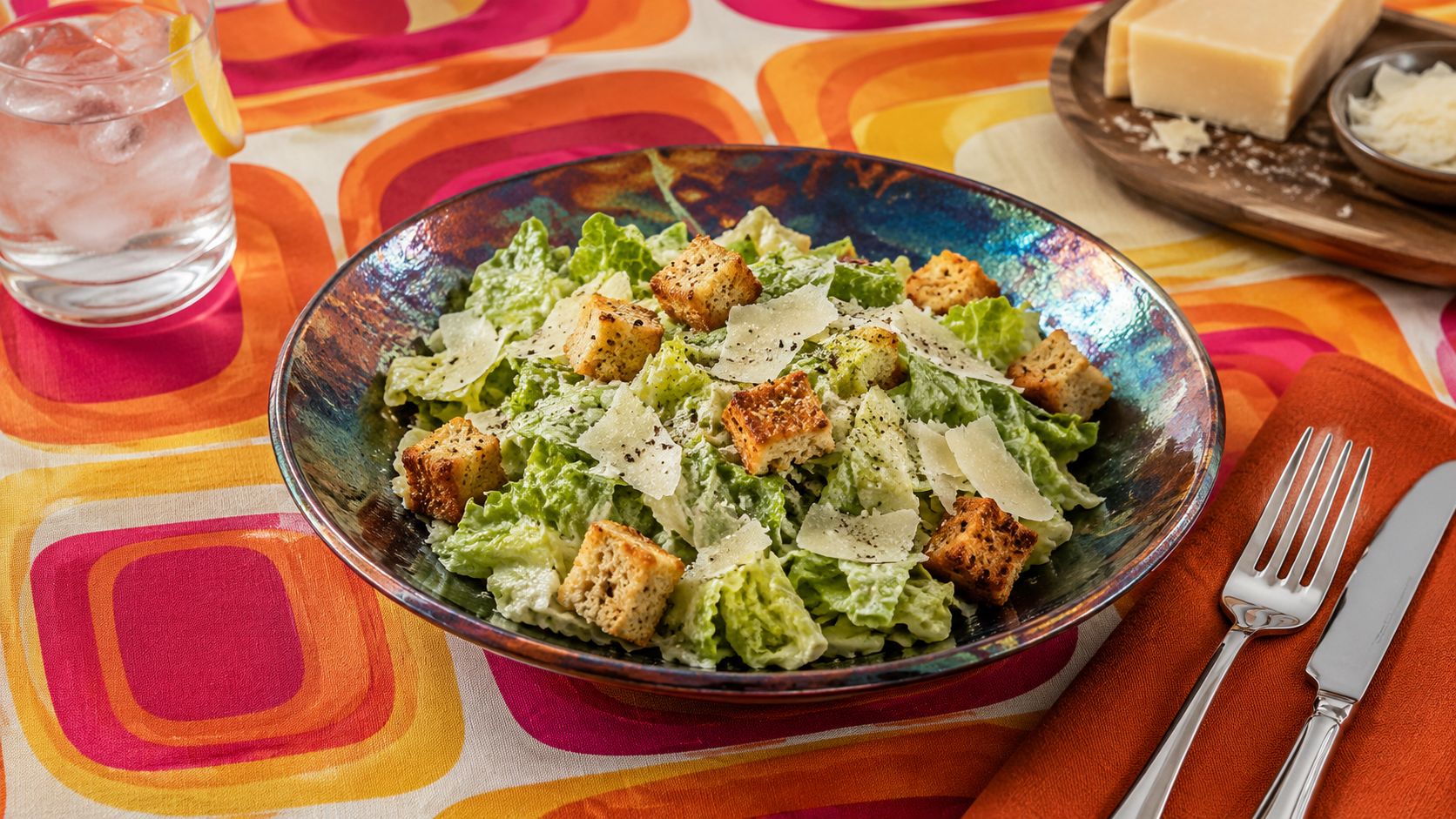
Caesar Salad Dressing: Bold, Creamy, From Scratch
Caesar salad dressing is made by whisking together anchovy paste, garlic, Dijon mustard, lemon juice, egg yolk, Worcestershire sauce, Parmesan, and olive oil until emulsified and creamy. It takes about 10 minutes by hand and keeps in the refrigerator for up to 5 days.
I used to order caesar salad specifically when I was at restaurants that I knew made the dressing in-house, because I had convinced myself that anchovy paste was not something a normal person kept at home and therefore the good caesar dressing was not something a normal person could make at home. This was a flawed line of thinking that lasted several years longer than it should have.
My friend Daniel made caesar dressing at home one night like it was nothing — whisk, garlic, a tube of anchovy paste he pulled from a cabinet like it was just a thing he had, lemon, Dijon, egg yolk, Parmesan. Five minutes. He dressed romaine with it and set it down and it was sharper and more savory than the restaurant version I'd been specifically seeking out.
Anchovy paste comes in a tube. You can buy it at most grocery stores. It doesn't taste "fishy" in the dressing — it tastes like the reason the dressing tastes like caesar dressing. That's the piece I'd been missing. Without the anchovy, you have a garlicky lemon cream, which is good, but it is not caesar. With it, you have something that coats every leaf and holds its flavor all the way through the plate.
I now keep anchovy paste in my cabinet. This is who I am now.
Ingredients
- 1 large egg yolk, room temperature
- 1 teaspoon Dijon mustard
- 2 teaspoons anchovy paste (or 3 oil-packed anchovy fillets, mashed to a paste)
- 3 garlic cloves, finely minced or pressed
- 3 tablespoons fresh lemon juice (about 1 large lemon)
- 1 teaspoon Worcestershire sauce
- 1/2 cup extra-virgin olive oil
- 1/4 cup finely grated Parmesan cheese (plus more to taste)
- 1/4 teaspoon kosher salt (adjust to taste)
- 1/4 teaspoon freshly ground black pepper
- 1–2 teaspoons cold water, to thin if needed
Instructions
- 1In a medium bowl, whisk together the egg yolk, Dijon mustard, anchovy paste, and minced garlic until fully combined and slightly thickened, about 30 seconds.
- 2Add the lemon juice and Worcestershire sauce. Whisk again until everything is incorporated.
- 3Now the critical part: with one hand whisking constantly, add the olive oil in a very slow, thin, steady stream —? almost drop by drop at first. This is what builds the emulsion. Rushing this is how you end up with salad soup.
- 4Once you've added about half the oil and the mixture looks thick and creamy, you can pour the remaining oil in a slightly faster thin stream, still whisking the whole time.
- 5Whisk in the grated Parmesan cheese.
- 6Taste and season with salt and black pepper. If the dressing is thicker than you'd like, whisk in cold water one teaspoon at a time until it reaches your preferred consistency.
- 7Use immediately or cover and refrigerate for up to 5 days. Whisk again before serving if it separates slightly.
Pro Tips
- Room temperature egg yolk emulsifies significantly better than cold. Pull your egg out of the fridge 20 minutes before you start, or set it in a bowl of warm water for 5 minutes if you forgot —? which I always do.
- Mince the garlic as finely as you possibly can, or use a microplane. Chunky garlic in a dressing is a texture experience nobody asked for.
- If your dressing breaks and separates, don't throw it out. Start fresh with a new egg yolk in a clean bowl, then slowly whisk your broken dressing into it just like you would fresh oil. It comes back together almost every time, which is more than I can say for most things.
Substitutions
Storage Instructions
Store in an airtight jar or container in the refrigerator for up to 5 days. The dressing may thicken or separate slightly when cold —? let it sit at room temperature for 5 minutes and whisk again before serving. Do not freeze.
Make Ahead
This dressing can be made up to 5 days ahead and refrigerated. The flavor actually improves after a day as the garlic mellows slightly. Make it Sunday, eat better all week.
Frequently Asked Questions
Do I really have to add the oil that slowly?
Yes, at least at first. The slow drizzle is what creates the emulsion —? the moment where oil and water-based ingredients stop fighting each other and become one creamy thing. Once the dressing has visibly thickened and gone glossy, you can speed up slightly. If you pour the oil in all at once, you'll get a greasy broken mess, and no amount of whisking will fully fix it.
Is it safe to use a raw egg yolk in caesar dressing?
The risk from raw eggs is real but small, and many people make traditional caesar dressing this way without issue. If you're pregnant, immunocompromised, or just not interested in the variable, use pasteurized eggs or substitute 2 tablespoons of mayonnaise instead. The mayo method is easier, forgiving, and tastes great —? I use it when I'm making this for large groups.
Why does my caesar dressing taste flat or bland?
Usually one of three things: not enough anchovy paste (it's the backbone —? don't skip or underdo it), not enough salt, or not enough lemon. Taste after you think it's done and adjust all three. Parmesan adds saltiness too, so add it before your final salt adjustment. A dressing that tastes aggressively seasoned on a spoon will taste perfectly calibrated on a leaf of romaine.
Can I make caesar dressing without anchovies?
You can. Mash a teaspoon of capers and add a small extra pinch of salt to compensate for the briny depth. Worcestershire sauce also contains anchovies —? if you're fully avoiding fish, use soy sauce or coconut aminos in its place. The dressing will be milder and less complex, but still very much worth making.
Can I make this in a blender or food processor instead?
Absolutely. Add everything except the oil to the blender, blend briefly to combine, then with the machine running, drizzle the oil in slowly through the top opening. It emulsifies even faster than by hand and the result is noticeably smooth. The hand-whisk version has a slightly more rustic texture that I personally prefer, but both are correct.
How do I store leftover caesar dressing and how long does it keep?
Refrigerate in a sealed jar or airtight container for up to 5 days. The garlic flavor intensifies over time, which most people find is an improvement by day two. Cold dressing may thicken or separate —? whisk it back together before using. Do not freeze this dressing; the emulsion will break and the texture won't recover.
Can I make this caesar dressing dairy-free?
Yes. Omit the Parmesan and add an extra teaspoon of anchovy paste, a small pinch more salt, and a squeeze more lemon to compensate for the flavor loss. You can also stir in 2 tablespoons of nutritional yeast for a savory, slightly cheesy note. The dressing will be thinner without the cheese, so whisk in less water at the end.
What's the best way to use this dressing besides caesar salad?
It's excellent as a dipping sauce for raw vegetables, a spread on a sandwich or wrap, a drizzle over roasted broccoli or cauliflower, or tossed with roasted potatoes right before serving. I've used it on grilled chicken, on grain bowls, and once on a piece of sourdough toast at midnight, which I'm not including in any official recipe but which was outstanding.